
 |
It’s the Thursday after Easter and most people out there are still picking the candy and chocolate out of their teeth having just gorged themselves on all manner of Easter Bunny-shaped confectionery. Ever the destroyers of convention, we have been doing something altogether more real and, some may say, sinister. Yes, friends, cover your children’s ears, for over the weekend, we — like Glenn Close in Fatal Attraction — put the Easter Bunny in the pot.
Easter traditions have a lot to answer for in the removal of rabbit from the American table. It is no coincidence that around the turn of the 19th century, fifty years or so after German immigrants had brought the habit of fashioning rabbits out of chocolate and sugar to the New World at Easter-tide, the amount of rabbit being eaten in the US fell into an almost terminal decline. It is only really in the last fifteen years that it has returned, and even now is commonly regarded with suspicion and, in many cases, horror. For what could be crueler than eating a lovely, cute and furry bunny?
Now, lest you think us heartless carnivores, I should point out that I am a big fan of rabbits – and I mean live ones. Not only did I have rabbits as pets for many years as a child and have very fond memories of how much fun they were, but I also believe that contrary to public perception, rabbits are in fact quite intelligent creatures with individual personalities and do make excellent pets.
So, you ask, how could I possibly, as my vegetarian sister puts it, “eat my friends� Well, readers, first of all, sadly, my rabbits both died nearly twenty years ago, so I am not (and would not) eat the rabbits that were my friends, and secondly, we did not put a pet rabbit in the pot as Ms. Close did, but rather we bought two skinned, headless and footless rabbits (at quite a hefty price) from a local butcher, rather like you would a couple of chickens. And, few, save perhaps fellow poultry, mourn the passing of a couple of chickens.
Then, to immortalize this fortunate (it was making an important contribution to our dinner – what an honor!) and extravagantly-priced creature, we prepared a delicious Provencal-style stew with olives, capers and tomatoes, the making of which we recorded to fashion our first We Are Never Full podcast! What better way to give thanks for the life of a noble beast than to prepare it for the hereafter with a savory, herby sauce and record this event for posterity in mp3?
But, regardless of your feelings about eating rabbits, it really was a truly memorable meal and an excellent recipe (see below). We hope you’ll listen to the podcast and let us know what you think about our first, amateurish foray into the world of multimedia production. We’re planning more podcasts for the future and expect to get much better at it with every attempt.
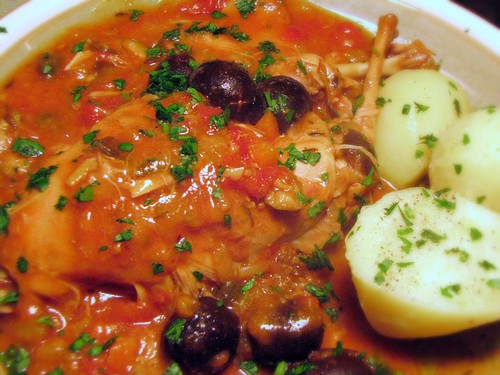
Provencal Rabbit Stew with Olives and Capers (serves 4)
Rabbit can dry out quickly when cooked because it lacks fat, so this stew works perfectly to keep the meat moist and to tenderize it through long, slow cooking. We ate it with some boiled potatoes for the first meal, then over some tagliatelle as a ragu the second time. Either way it’s delicious and would also work well over rice or just served with some crusty country bread.
Ingredients
1 large rabbit (2-3 lbs)
2-3 tbsp olive oil
½ cup plain flour
½ cup smooth Dijon mustard + 2 tablespoons extra
2 cups coarsely chopped onion
½ cup coarsely chopped carrot
1 cup white wine (whatever you plan to drink with the meal)
1 large sprig thyme
1 medium sprig rosemary
1 bay leaf
1½ tsp tomato paste
5 finely chopped garlic cloves
3-4 cups chicken stock
1 16-0z can of whole, peeled tomatoes (tomatoes only, no juice)
¾lb brine-cured green olives (without pimentos)
1 can black olives, drained
¾ cup capers (large, not nonpareils)
¼ cup finely chopped/chiffonaded parsley
 |
 |
 |
 |
 |
 |
 |
Recipe
1. Preheat oven to 375F
2. Cut rabbits into 6 pieces: hind legs (2), forelegs (2) and center-loin/spine (cut in half) or have your butcher do this for you.
3. Brush the rabbit pieces with mustard and then dredge them lightly in flour, shaking off excess.
4. Put a large, high-sided ovenproof pot (we used our big enameled cast-iron Le Creuset) over medium heat and add olive oil.
5. Add rabbit and brown on both sides – 2-3 mins per side or until golden brown. Remove and set aside
6. Add the onions and carrots to the pot and cook over a slightly higher heat until onions have some color. Sprinkle in the leftover flour, if any remains, and stir well into onion. (Additional oil may be necessary here if pan is dry.)
7. Deglaze pot with white wine over high heat and mix well to get all the crusty bits off.
8. Add the thyme, rosemary and bay, extra two tablespoons of mustard and tomato paste and garlic. Mix well.
9. Return rabbit to pot. Add plum tomatoes, olives and capers and add enough chicken stock to cover meat and vegetables by about an inch. Bring to a boil. Cover and braise in oven for 1½ hours or until meat has begun to pull away from bones.
10. Return pan to stove top and reduce sauce by about half. You may also thicken sauce with flour, if desired.
11. Check seasoning and sprinkle with the parsley.
12. Serve. Bowls are best, we found. Enjoy!
Thanks to Dean & DeLuca for the base of this recipe.
Please note that we are FINALLY up on iTunes. Check out all our podcasts
CHECK OUT SOME OTHER POSTS YOU MAY ENJOY:
- Spanish Easter Bread – Hornazo
- The Wrong Message from a Former Prophet (Delia Smith Jumps Ship)
- Fabada: A Mortal and Corporal Sin – But Worth It!
- Jamon, Jamon
- FRITO MISTO DI MARE (FRIED MIXED SEAFOOD AND VEGGIES)
- PERFECT BROCCOLI DI RAPE WITH SWEET SAUSAGE
- ROASTED PORK SHOULDER (Pernil) – The Low and Slow Method
- PAPPA AL POMODORO (Tuscan Tomato and Bread Soup)
My CS told me thats what they eat on Easter in Germany. I found it odd. But when you think about it we eat chocolate bunnies and cute little lambs. I had his Moms rabbit and it was so yummy.But this provencal style looks more to my liking.
How much did you pay for rabbit???
Here in Spain rabbit is cheap so I’m going to be trying out your recipe (great, mouthwatering photos btw).
About the podcast: Amy – you don’t sound like you’ve got a penis, but you do sound as if you’re talking on the phone. The format is fine. Did you record with Audacity or some other software? Are you Mac or PC? Feeder http://reinventedsoftware.com/feeder/ is really easy software for doing podcast feeds to iTunes on a Mac -I don’t know about PC’s. I’ve been doing podcasts for some time, so If you need anyhelp send me an email?
This whole post is wickedly funny and your podcast is awesome! I was just fixated on listening to your beautiful voices and the whole interesting process!
Todd loves rabbit and has made it. Then I first read your post, I was thinking….”Gosh, rabbit $$$ is expensive!”. After the read, I listen to your podcast and you guys re-affirmed the pricy price tag of rabbit! $60 dollars for two? Wow, but your stew came out marvelous and it was worth it. Also, you extra addition of garlic is even better!
Okay, who’s voice is who? LOL
Rabbit is sadly delicious but hey…the multiply like..rabbits! Us Greeks make a rabbit stew called Stifado and it’s marinaded in wine and the lots of onions (as you have) helps with the gameyness.
Got guests coming over? Tell them it’s chicken!
great first podcast, keep it up.
Listening to you two now and your telling the bugs bunny story 🙂 We grew up eating rabbit (yes in nyc) and rabbit is a popular Maltese dish, if you try it out again, hope you’ll give a Maltese version of rabbit stew a go. I can’t believe it cost you $60 (did i hear that correctly???) to buy two rabbits! And it’s great to hear you two. 🙂
oh and I’ll have to star this one too as I have a rabbit in the freezer to use up and always looking for different versions…and it only cost about $7 btw
I don’t think I’ve ever had rabbit before. I’m gonna have to give this a try:-)
60 bucks for a pair of bunnies? Almost every time I visit my mother (on our family farm in Central Texas) I manage to pot a few cotton tails. I can’t imagine spending that much on them! 🙂 I guess it’s like having access to fresh corn and homegrown tomatoes, so I’m just spoiled. I’ll definitely be trying your recipe, it sounds fantastic!
I’m really late with this comment, but I just found this post/podcast. I’ve eaten rabbit all my life, and never thought much about it, however after listening to you guys talk about pet bunnies/the Easter Bunny, etc. I suddenly feel guilty. I really wish you hadn’t even brought up the subject of ‘pets’. I don’t think it’s necessary. Most people who eat rabbit don’t even consider pet bunnies. Most of the ones we have as pets are entirely different breeds from market rabbits. I think you might have turned more people off of the idea of ever eating rabbit than you have convinced to try them. I think that’s sad. And, honestly, I think the next time I want to buy rabbit I will remember this podcast and might not be as enthusiastic about cooking it as I used to be. I hope you don’t take offense at this, but I just had to tell you how it made me feel. I’ve enjoyed the rest of your website so far, at least until right now. I’m sure I’ll be back…you can’t keep a real ‘foodie’ down for long.
Carolina – thanks for your visit and comment. No offense was taken at all – quite the opposite in fact. It was fascinating to hear that you were looking at things from the opposite viewpoint than what we would assume to be the norm in most of America, i.e. bunnies are pets first and foremost, and (very) secondarily they are dinner. Certainly, continental europeans have no such compunction about putting thumper in the pot, but Americans seem to be squeamish about it.
Your point about the breeds being very different (pet vs. dinner) is as well-taken as it is correct, and, apart from our suggestion that people just simply try to get over the cute, furriness issues of eating rabbits, this is a useful tactic in discussions with those who would think it cruel. You may have gathered from our podcast and post that while we are definitely animal-lovers, we took an almost perverse pleasure in making and enjoying a meat that many would find philosophically problematic, so we hope that you, who began as a rabbit-eater, are not put off for long.
I am so sorry, but I find this so repugnant, where do you draw the line, will there be recipes for cat and dog next? Not as stupid as it sounds, I, as have many friends, have companion rabbits, their life span is 8-10 years and they have an intelligence much the same as cats and dogs! I have a husband and three children, also part of our family and much loved, are a cat, a dog and two house rabbits. They are toilet trained, come when called, do tricks for treats, have vastly different personalities, run to the door to greet people, so how different are they to the dogs and cats that we don’t or wouldn’t ever consider eating? Or would we?
Factory farming of any animal is cruel and most people are not aware of the facts or choose not to be aware, or they may have to confront the horror of their living conditions, they are sentient beings, I don’t expect people understand until they have seen the reality of what great companions they are and STOP eating them!
I just wonder if you will allow this post through, I expect not :0( I feel very sad that my view point may not be allowed. . .
I wish you all the best and I also wish you would reconsider eating rabbit . . . .
@Elise – thanks for your comment. As you can see, we’re perfectly open to a debate on this, and you are quite entitled to your views. As you may have noticed had you listened to our podcast, I too had a house rabbit for many years growing up. He was a charming fellow of infinite jest and great personality, and a fabulous pet that my whole family loved dearly. We too vehemently oppose factory farming of rabbits or of any kind of animal, but I think you need to be careful about where you draw the line in terms of personality automatically equating to inedibility. Cows, pigs, sheep, deer, even geese and ducks may have winning personalities, but because they don’t make good house pets, does that mean we can eat them? And just because dogs and cats can share a roof with us, they are off the menu? It’s an absurd point, and ignores the fact that people have kept domesticated animals for millennia more for what they can gain through owning them than because they were entertaining company. Cats kept the rodent population in check, dogs protected against wild animal/human attacks, cows provided milk and leather (and beef), chickens provided eggs and feathers (and meat), sheep provided wool and milk (and meat), and pigs were both an effective waste disposal system and very delicious. Rabbits were, for most of human history, just another form of livestock, and frankly, in the times we live in, should be reconsidered as a viable alternative to other meats as they are both a healthy and sustainable source of food. They breed and mature rapidly, require comparatively little fattening compared to other livestock, including chickens, and yield lean, tasty meat. I should also add that the breeds of rabbit sold as pets are entirely different from the breeds kept as livestock, and are much closer in look and behavior to their wild ancestors, not that this will change your dietary proclivities, I’m sure, but it’s a good point that we’re not eating our pets/friends/family, but other creatures that look similar, but really aren’t very much the same at all.